There are projects you plan carefully. You choose the yarn, the pattern, the colourway. You swatch. You consider. You cast on with intention.
And then there is Scrappy.
The Problem With Merino
For years I have wanted to crochet a genuine wool blanket for my bed. Not an acrylic blanket. Not a cotton blanket. A real, animal fibre blanket — the kind that breathes and warms and gets better with age.
The problem is Merino. It is not cheap, and a bed blanket requires a great deal of it. I could not justify buying the quantity I would need for a project of that size, and I refused to compromise on the fibre content.
So I found another way.
What Scrappy Actually Is
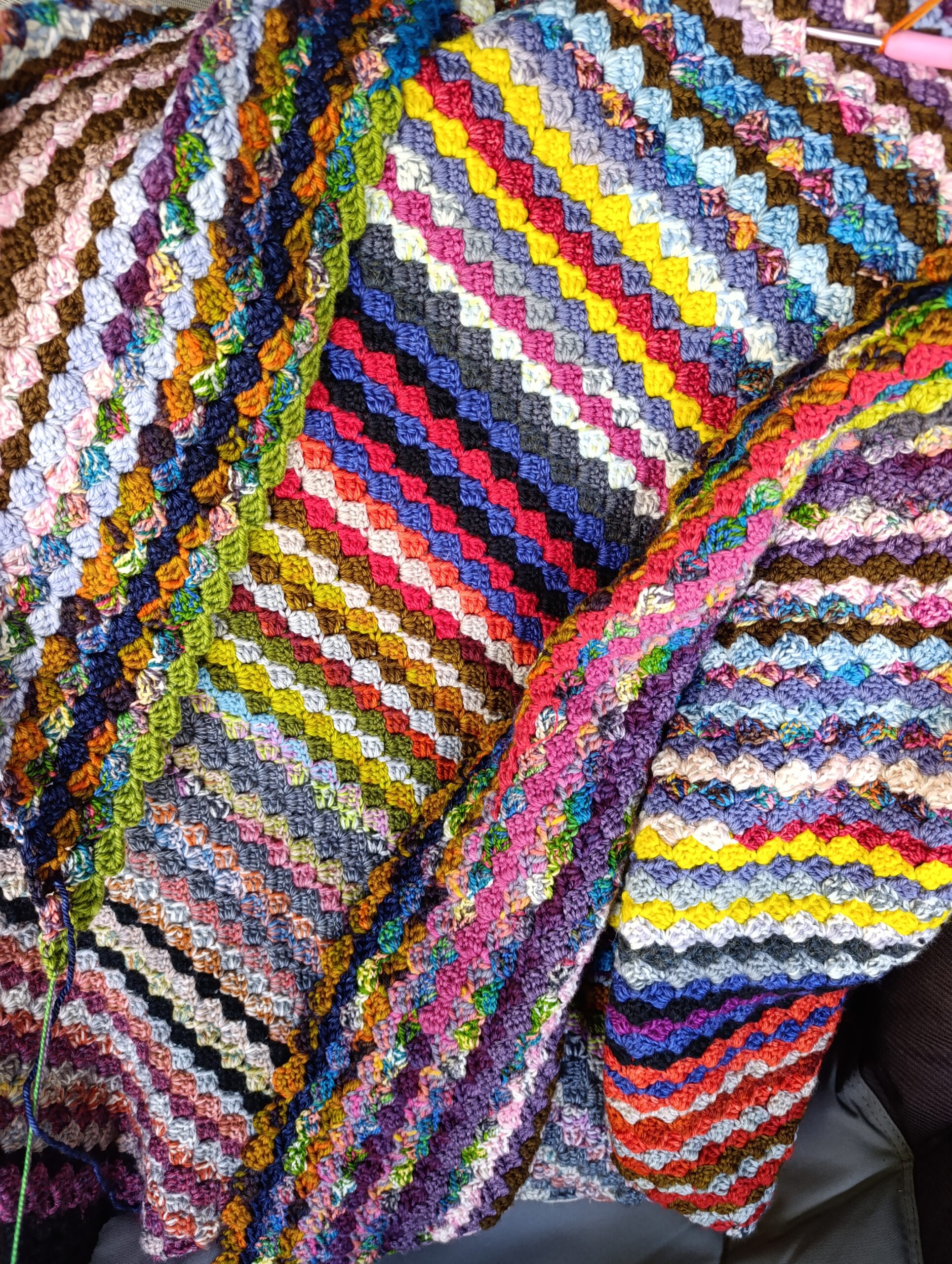
Scrappy is a corner-to-corner crochet blanket worked on a 4.5mm hook, started with a small amount of black Colourspun Merino Aran that was left over from another project.
That is the only rule: whatever animal fibre I have left over from a finished project goes into Scrappy. The hook size stays the same throughout. The yarn weight does not.
Aran weight scraps go in single strand. DK scraps get held double with a lace or light fingering alongside them. Fingering weight scraps might go in double, or triple strand using the chain ply method I shared yesterday — one continuous strand of yarn folded into three working strands, no cutting, no joining.
There is no colour plan. There is no stitch variation. There is no design decision beyond picking up whatever is next in the scrap basket and starting the next section.
Scrappy currently contains Merino, Yak, Alpaca, Mohair, Silk, Cashmere, Possum, Arapawa, and Polwarth.
It is, as a result, extraordinarily soft. And completely wild in colour.

The Broom
Here is the part I want to talk about properly.
When I finish a big project — a design that has taken months, that has been tested and revised and photographed and published — I feel lost.
This is not something that gets discussed much in crafting spaces, but I think it is very common. You have been entirely absorbed in one thing. Every part of your brain has been occupied. And then it is done, and suddenly there is nothing in that space, and the absence of it feels disorienting.
I cannot immediately start the next design. My brain needs time to process what just happened — to review what I liked, what I would do differently, what the project taught me. I need closure before I can move forward.
But I also need my hands to be busy. Idle hands are not something I do well with, and that is not a figure of speech.
Scrappy is the answer to both of those things at once.
I do not have to think about it. There are no decisions to make. No colour choices, no stitch counting, no design problems to solve. I pick up the hook, I pick up whatever scrap is next, and I crochet corner-to-corner until my brain has finished doing whatever it needs to do with the project just completed.
I call it a broom for my brain. It sweeps out the previous project and makes space for the next one.
When I finally feel ready — when the closure has arrived and the ideas start forming again — I put Scrappy down and begin designing.
The Colours
Scrappy is, by any objective measure, ridiculous.
Variegated yarns. Solid colours. Different variegateds held together creating something entirely new. Colours that have no business sitting next to each other, doing exactly that without apology.
It is the kind of colour combination that would make my planning brain deeply uncomfortable — if I let it. But I made a decision early on to refuse that discomfort. No planning. No editing. Whatever comes next, comes next.
I am too far in to change anything now, which is perhaps the most liberating thing about Scrappy. The decision has already been made. I just carry on.
What surprises me is how much I like it.
It reminds me of the old-fashioned patchwork blankets made by generations of women before us — the ones where nothing matched and everything worked, because the maker simply used what she had and refused to overthink it. There is a kind of freedom in that approach that I do not often allow myself.
Scrappy gives it to me anyway.
The Fibre Rule
There is one non-negotiable: Scrappy only accepts animal fibre.
This occasionally creates a problem. When a large design is made in cotton — which happens, because cotton has its place — the leftover scraps cannot go into Scrappy. Cotton and wool do not belong in the same blanket, and more practically, cotton does not have the warmth and loft I am building toward.
So I keep a small reserve. Now and then, when I buy yarn for a smaller project, I add an extra 50g ball of something animal-based — just for Scrappy. Insurance against a cotton-heavy period in my designing.
It is the only planning Scrappy ever gets.
What Is In There
At the time of writing, Scrappy contains fibres from:
Merino. Yak. Alpaca. Mohair. Silk. Cashmere. Possum. Arapawa. Polwarth.
It will be, when it is finished, one of the most extraordinary blankets I have ever made — not because of any design decision I made, but because of every project that came before it.
Every scrap in there was once something else. A sweater. A hood. A cowl. A beanie for my son in the mountains. All of them distilled down to their remainders and woven, without plan or ceremony, into something new.
I think that is rather beautiful, actually.
A Note on the Newsletter
If you used to receive my blog posts by email and have not seen one in a while — this is why.
I have moved to a new newsletter platform. Previous subscribers were not automatically transferred. Although I imported you all, you were sent an opt-in email and I suspect many of those landed in your spam folder. To continue receiving blog posts and updates directly to your inbox, you will need to either resubscribe using the widget on the right, or check your junk mail for the opt-in email sent 7 July 2026.
I would love to have you back.
Scrappy is ongoing and unfinished, which is exactly as it should be. She will be done when she is done.


Your Scrappy is gorgeous! When you talk about scraps of yarn, what sort of length do you mean?
There are some that were less than 1m. Some even less than that. Some only made a few dcs and I am okay with that.