In 2014, my hands started talking back.
I had been running Yarn in a Barn for about a year at that point, and the discomfort when knitting or crocheting was impossible to ignore. I went to the doctor, who gave me advice I did not expect: do not stop. The movements were good exercise. But he sent me to a hand therapist to make sure I was not making things worse.
I saw Corianne van Velze in Pretoria.
We worked through knitting first. Circular needles made an immediate difference over traditional straight pins, which place significant load on the wrists. We looked at English versus Continental knitting and found little difference between them, but the way I tensioned yarn around my little finger was a problem regardless of style. Eventually we landed on Portuguese knitting, which distributes the load very differently.
Evaluating my crochet was more interesting.
Neither knife grip nor pencil grip is exclusively correct. The grip depends entirely on the crocheter. What matters is that there is an arch in both the thumb and the index finger. If either collapses into a reversed arch, it can become a lifestyle trigger for arthritis. At the time, I was using an old aluminium hook with a pencil grip, the way my mother had taught me. I had to change. The only way I could get my fingers to behave was to switch to a knife grip. But with a knife grip, the hook felt lost in my hand. Too small. Too thin. It sat wrong. So I started hunting.
Many evenings that year, instead of reading before bed, I was on my phone searching for a hook that would work. I found Furls, an American brand making ergonomic hooks with beautiful wooden handles. They were exactly what I needed. They were also in the United States, which meant international courier fees and import duties on top of an already high price.
I hesitated for weeks. Eventually Dries looked at me and said: order the hook. It is the right tool for the job.
So I did. By the time it landed in my hands, that single hook had cost me over R1,600. Worth it, mostly. But it stabbed me in the palm near my wrist. The handle was not long enough for my hand, and I was gripping it so hard to compensate that it was creating a new problem.
Dries said: let us make our own.
That Sunday, in the Bistro in a Barn, Jan Phyffer walked in carrying wooden toys he had made himself. He was looking for somewhere to sell them. I asked if he would consider making a crochet hook. He probably thought I had lost my mind. But he said yes.
What followed was months of prototypes. Each one came back to him with notes. Adjust the taper. Lengthen the handle. Change the angle of the throat. I drove that man close to complete insanity. He never said so, but I suspect he came close. Eventually, we had an inline hook we were both very proud of.
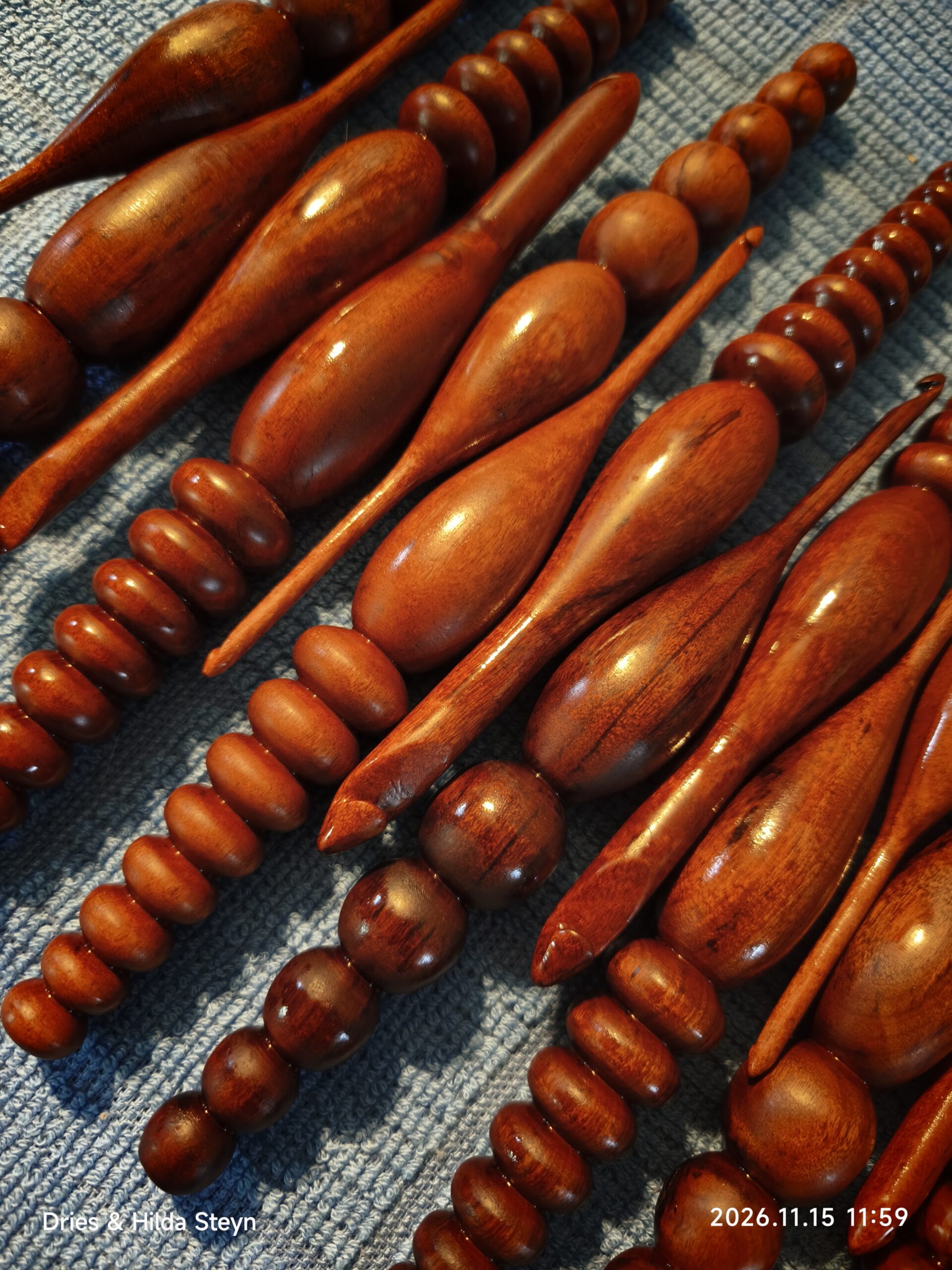
The Ilona Heritage Hook was made from Rhodesian Teak. Ergonomically shaped to encourage a healthier grip. Long enough that it did not stab me in the palm. The right weight. Every hook was tested by me personally before it left my hands.
We sold a great many of them.
Then life changed direction, the shop closed, and the hooks went into storage with everything else.
Last week, I opened my craft crate and the first thing I reached for was my wooden box. Having my favourite hook back in my hand felt like coming home.
They were dry after two years in storage, so yesterday they got an oil treatment. Dipped in Woodoc, left to absorb, then dipped again. Rested properly before being used again.
I had a chat to Jan yesterday. After all these years, he is willing to make hooks again.
The Ilona Heritage Hook is back and will soon be available to order on my website.

Ek sal een koop wanneer hulle beskikbaar is.