
There are things you do not warn people about before they marry a yarn snob.
Performing a burn test on a jacket purchased at an indoor market in Mossel Bay on a Saturday afternoon is apparently one of them. My husband took it in his stride. He is used to me by now.
The Goods Shed, Mossel Bay
We are currently based near Kleinbrak in the Western Cape, which puts us within easy reach of Mossel Bay on a Saturday. The Goods Shed is an indoor market — the kind of place you wander through without a specific intention and leave having made a decision you did not anticipate.
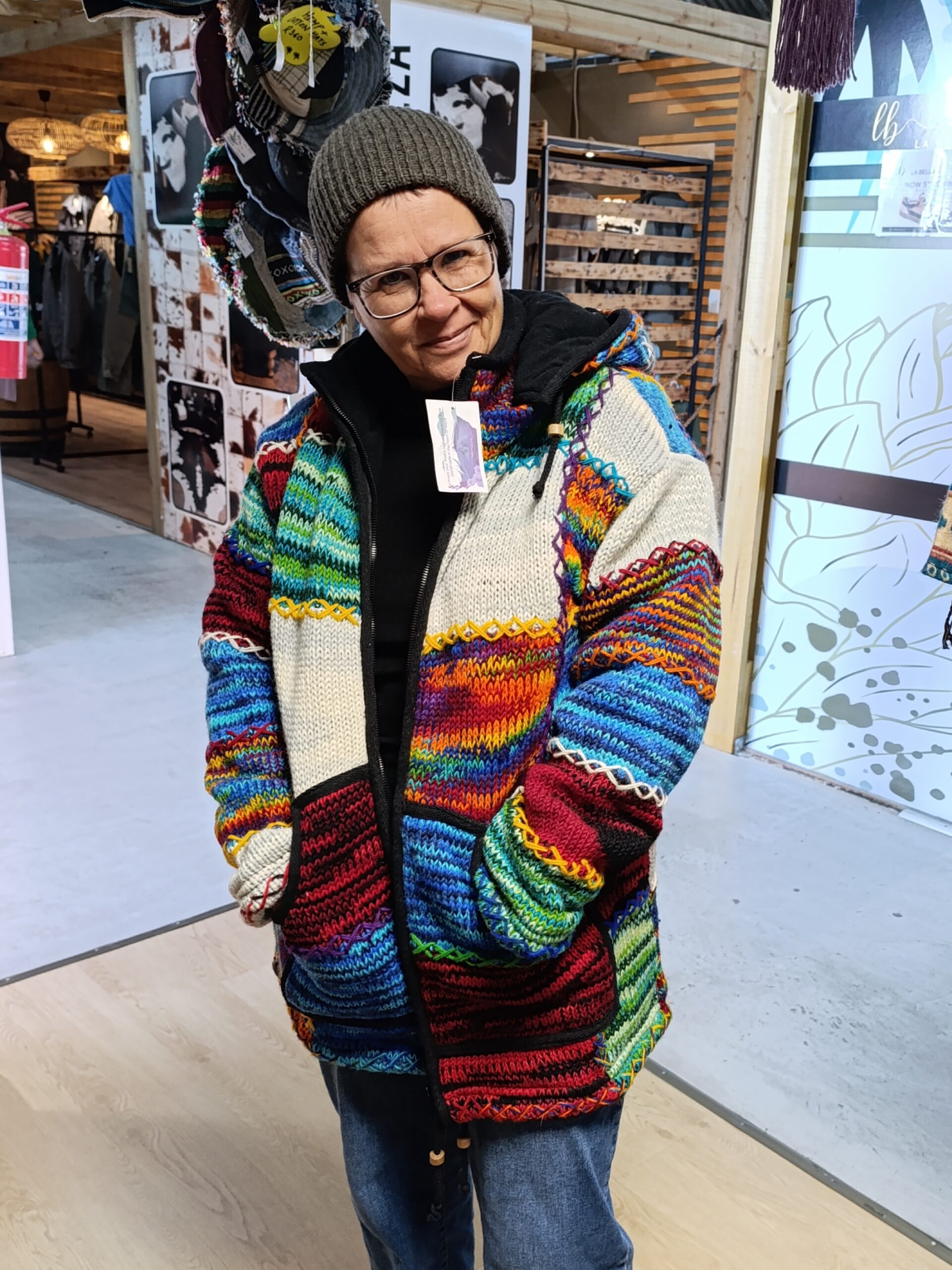
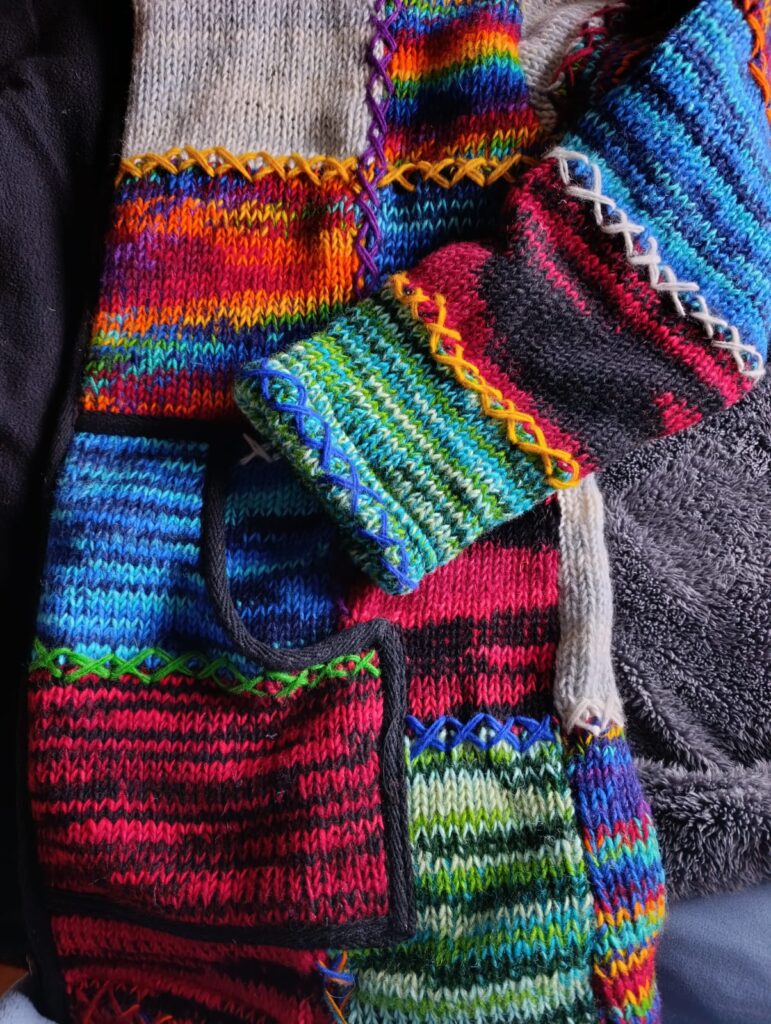
My husband spotted a jacket. Multicoloured, patch knitted, long — comes to just below the bum. Bold. Colourful. Exactly my kind of thing.
He bought it for me. You can see the smug look on my face when I fitted the jacket in the shop. The price was R1,750.
The tag said made in Nepal.
The Assumption
At R1,750, I assumed acrylic. The jacket is thick, lined with fleece on the inside, and generously sized. For that price point, with that construction, wool felt optimistic.
Then I read the Soul Wear website. Their brand — Bohippie Boutique — makes a claim about natural fibres. Handmade in Kathmandu, ethically crafted, natural fibre content.
I appreciated the claim. I did not immediately believe it.
This is not cynicism. This is experience. The word “natural” appears on a great deal of clothing that, when tested, turns out to be anything but. I have been doing burn tests long enough to know that a label is a starting point, not a conclusion.
You can watch the video at the bottom of this blog.
The Burn Test
For those who are not familiar with it: the burn test is a simple, reliable method for identifying the fibre content of an unknown yarn or fabric. You take a small sample, expose it to a flame, and observe what happens. The behaviour of the fibre — how it burns, what it smells like, whether it self-extinguishes, what the ash looks like — tells you whether you are dealing with a plant-based fibre, an animal-based fibre, or a synthetic.
I used to demonstrate this as part of a workshop I presented called The Crochet Guide to Greatness. It was always one of the most memorable parts of the session — there is something deeply satisfying about watching people realise they can identify fibre content themselves, with nothing more than a lighter and a little knowledge.
What the Jacket Told Me
On Saturday evening, back at the caravan, I pulled a few loose strands from the inside stitching of the jacket.
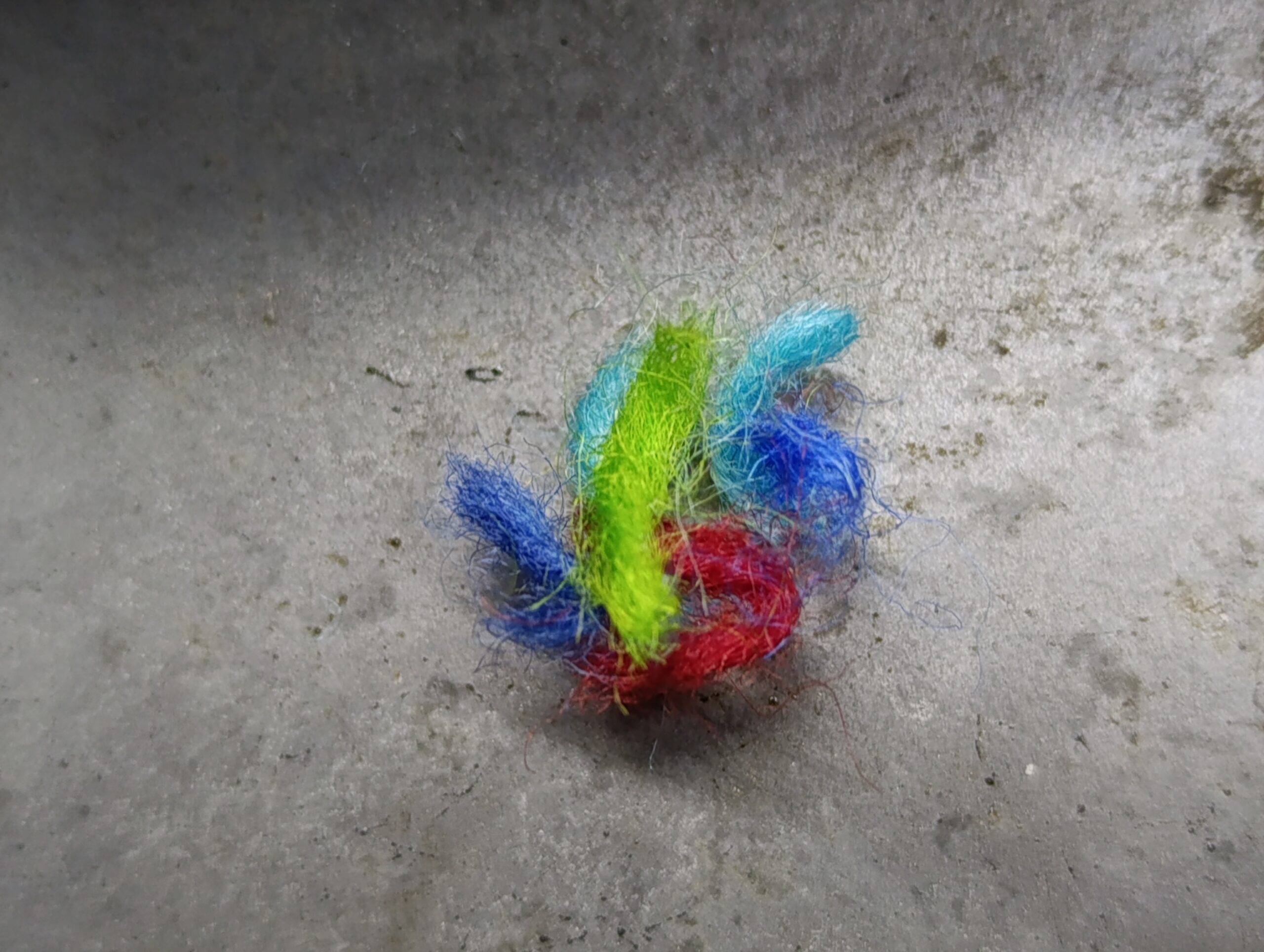
The results were unambiguous.
The yarn smelled like burnt hair when exposed to the flame — the characteristic smell of animal protein burning, quite distinct from the chemical smell of a synthetic or the papery smell of a plant fibre. The flame self-extinguished the moment the heat source was removed. The smoke was white. The ash was soft and crushable, not hard or beaded.
Every indicator pointed in the same direction.
Animal fibre. Without question.
The Verdict
I am genuinely impressed.
A patch knitted jacket, made by hand in Kathmandu, lined with fleece, long enough to be properly warm, in animal fibre — for R1,750. That is remarkable value for what it actually is. I went in expecting acrylic and came out with wool.
Soul Wear’s claim about natural fibres is not marketing language. It is accurate.
The jacket is beautiful. It is warm. It smells like burnt hair in the best possible way, which is a sentence I never expected to write but stand behind completely.
The jacket has deep pockets! Yeah! AND a hoodie! Double Yeah!
Why This Matters
I am a yarn snob. This is not something I apologise for.
I do not work with acrylic yarn. Not because acrylic is without merit — it is washable, affordable, and durable — but because the behaviour, feel, and warmth of natural fibres is something I am not willing to give up. Animal fibres breathe. They regulate temperature. They have a softness and a life to them that synthetic fibres do not replicate, regardless of what the packaging claims.
Knowing what your yarn — or your jacket — is actually made of is not a niche interest. It is useful information. It affects how you care for the item, how it will age, how it will perform in cold weather, and whether it is worth what you paid for it.
The burn test takes thirty seconds. It tells you the truth.
A Note on The Goods Shed
If you find yourself in or near Mossel Bay on a Saturday, The Goods Shed is worth your time. The kind of market where the unexpected find is part of the point.
My husband has excellent taste. I am willing to put that in writing.
Soul Wear — Bohippie Boutique can be found at www.soulwear.co.za


Wow Ilona that is a gorgeous jacket and for that price – natural animal fibre. Dries you truly love that dear wife of yours and guess what – you have very good taste – in choosing a woman and clothing.
May I add, you can also use the burn test on leather. My late husband taught me how. Synthetic will turn into a lump of hard plastic whereas genuine leather has no effect on the flame.
Ilona I get quite heartsore as we always visited The Goods Shed when in the Mosselbay area before my husband passed away. I miss those wonderful days as we were also devoted campers – my late hubby also had great joy in spoiling me with gifts he knew I had a weakness for.
I do hope this rainy weather clears for a while now and the sun shines for you and Dries so your camping gear can dry up a bit and you can sit outside and enjoy your knitting and the warmth. Kind regards Charmaine Schmidt