I want to write about something that has been sitting heavily with me, and I am going to do it with the full awareness that I use AI in my job as a Power Platform developer, and to keep up with the social media side of Ilona Slow Life Creations. Claude helps me write my emails, blog posts, my social media captions, and my workshop manuals. I am not pretending otherwise, and I do not think using AI as a writing assistant is the issue I am about to describe.
The issue is something else entirely.
What I Asked
Over the weekend I posted two questions in a Facebook group for designers. What is the part of the job you really do not like? And what is the one thing that makes you wonder whether it is worth it? I had my own reasons for asking. But the responses I got stopped me in my tracks, and I think they need to be heard beyond that group.
Here is what some of my colleagues said, in their own words:
“I am struggling to keep going at present. Thieves are making more from my designs than I am most of the time. People don’t know what is mine and what isn’t. Etsy is allowing so much AI rubbish that people are afraid to buy anything. I am just really tired of it all. What was a thriving business has virtually collapsed.”
“I feel the same, thieves using AI to change my images and selling on Etsy. I filed over 20 on Etsy’s reporting portal today, some of the shops only been open a month and made 400 sales, probably more than me, there’s no point in continuing.”
“I’ve pretty much given it up, to be honest. My website trickles along by itself earning a wee bit of ad revenue. Virtually no pattern sales on Etsy anymore. Occasionally on Ravelry. Honestly don’t want to put the time and effort into creating any more patterns. AI and theft have destroyed our industry.”
“I haven’t made a pattern in over a year. It’s hard when people are making patterns using AI and selling them, people complain that the images are not the same as the pattern. Most of those patterns look like photographs. And the patterns that actually work out the same as the picture, I just can’t compete with that. I refuse to use AI to make a pattern. I take weeks drawing the picture to the point where I’m happy with it, then a few more weeks converting the picture to a workable pattern. Then I write the pattern. I test most of my patterns myself before getting testers to double check for any errors before I publish. Yet there are designers out there publishing a huge blanket pattern every two days.”
“So many people taking others’ designs. When I go onto Etsy and look for a pattern, I click for details because the main pictures are AI. The market is saturated. What makes me keep going is seeing someone’s face light up when they see something handmade, or hearing that a child has slept with a plushie every night.”
These are not bitter people having a bad day. These are skilled, experienced designers who have spent years building something, and who are watching it be dismantled by a combination of AI image generation, intellectual property theft, and a marketplace that is either unable or unwilling to police what is happening on its own platforms.
What AI Can and Cannot Do
I want to be specific about this, because the conversation tends to get muddled. AI can generate an image that looks like a finished crochet blanket. It can produce something that, in a thumbnail on Etsy, looks indistinguishable from a photograph of a real, handmade item. It can even generate text that looks like a pattern.
What it cannot do is pick up a hook or needles and make the thing.
And that matters enormously, because a crochet or knitting pattern is not just a description of what something looks like. It is a set of instructions that have to work in real yarn, with real hands, in real time. Every stitch count has to be right. Every increase and decrease has to be placed correctly. Every construction decision has consequences that only reveal themselves when you are halfway through and something stops adding up.
I write patterns. A pattern I publish has been designed by me, made by me, and then tested by other human beings who work through every step and come back to me with every error, every ambiguity, every place where the instructions could be clearer. That process takes weeks. Sometimes months. For a large design, longer.
An AI-generated pattern has been through none of that. The image looks stunning. The pattern underneath it may be completely unusable. The people in those reviews are not wrong when they say the finished object looks nothing like the picture. It cannot, because the picture was never made from the pattern. The picture was generated first, and the pattern, if it exists at all, was assembled afterward without anyone ever actually making the thing.
What This Means for Buyers
If you buy a pattern from a legitimate designer you trust, you are buying something that works. You are buying the hours of design, the test makes, the revisions, the photography, and the customer support when you have a question three rows from the end.
If you buy an AI-generated pattern from a shop that opened last month and already has four hundred sales, you are buying a gamble. You may get lucky. You may not. And the money you spend does not go to anyone who made anything.
Here is what I would ask you to do before you buy a pattern anywhere, but especially on Etsy:
- Look for reviews that include photos of finished objects made from the pattern. Not the listing photos. Not AI-generated images. Photos posted by real people who worked through the instructions and came out the other side with something they can hold.
- Look on Ravelry. Search for the pattern name or the designer. If real people have made it, there will be project pages. You will see their versions, their comments, their modifications. That is the closest thing to a guarantee that the pattern actually works.
- Check the designer’s history. How long have they been publishing? Do they have a website, a social media presence, a community around their work? A shop that opened last month with hundreds of sales and no visible human being behind it is telling you something.
My bio states: Designs by a human, tested by humans.
I know it guarantees nothing. Anyone can put something like that in a bio. But I am trying to say something true, and I want you to hold designers to it. Ask questions. Look for evidence. Support the people whose work you can trace back to actual hands. When you complete a project successfully, please post a positive review. Tell other buyers that the pattern is written well, tested well and that you enjoyed it. Pass the link to the pattern to your social craft circle. Create a project in Ravelry. Help us to fight this unfair fight. If we as designers lose this fight, you lose too. Eventually the only patterns on offer will be AI junk.
For the Designers
I have nothing encouraging to say to my fellow designers today. I am sorry. I wish I did.
I feel the same exhaustion they described. I feel the same sense of fighting something that does not fight fair and does not get tired. I feel the same frustration of spending weeks on something that a thief can replicate and sell in an afternoon using tools that do not understand what they are copying.
What I can say is this: the people who buy from us, and who have always bought from us, are not stupid. They know the difference when they see it. They have made our patterns and they know what it feels like when instructions are written by someone who actually made the thing. They come back. They leave reviews. They post their finished projects. They tell their friends.
That community is real. It is smaller than it used to be, and it is working harder than it should have to. But it is real.
Hold onto that. Some days it is the only thing worth holding onto.
A Final Note
I said at the beginning that I use AI as a writing tool, and I want to return to that honestly. Claude helps me write. As a neuro-diverse person, my style of writing is often too harsh for neuro-typical people. Claude softens that. Especially in emails. Before Claude, my poor husband had to do the editing to make sure I don’t offend people. Claude creates graphics when I need it, like the front page of my latest workshop manual for The Art of Choosing. Claude does not design my patterns, make my swatches, count my stitches, or test my instructions. Those things require hands, and time, and the willingness to frog something three times until it is right. He doesn’t even get to edit my patterns.
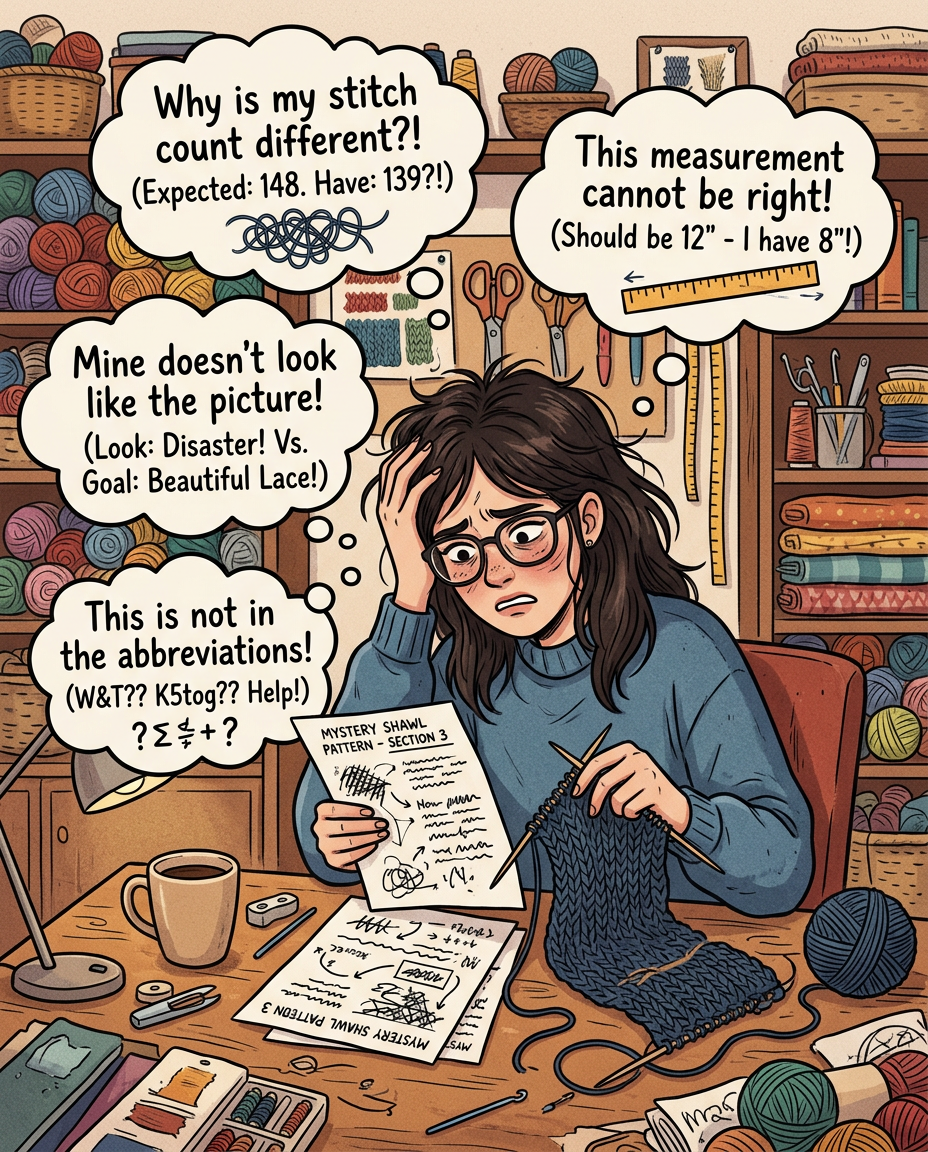
I generated the graphic for this blog post with Adobe Firefly. It saved me time and perfectly illustrates my point. Did you notice that the poor woman in the picture has three hands? That is AI for you.
Will I ever design with AI? NEVER! Saving time but compromising my reputation doesn’t make sense at all.
The line I am trying to hold is the one between using a tool to help communicate something human, and using a tool to replace the human part entirely. I think that line matters. I think most crafters, if they think about it clearly, know exactly where it is.
Designs by a human, tested by humans.
That is still what I am. I intend to keep being it for as long as I can.


thank you Hilda for writing diverse topics I am a blind knitter and crocheter and would like to help follow disabled crafters to enjoy designer’s patterns by testing them for you designers and that we will never be able to do for ai. So please continue raising topics on conflicting diverse topics it’s necessary and do not stop designing each designer is unique.
Thanks Jess.
Dankie Hilda ek het nie eers geweet van die goed nie Sal beslus 2x dink voor ek patroon op Etsy koop Snaaks die 3 patrone wat ek maak van lap is perfek
Almal op Etsy is nie noodwendig sleg nie. Etsy se maatreels is net ongelukkig baie slap, so kyk maar mooi voordat jy geld spandeer.